Where it started
Vitaliia had been watching The Body School for a long time before she joined. She is 46, a mother to a son she very much wanted to model a healthy relationship with food for. She practised yoga four to five times a week for over a year. The number on the scale never moved.
Then the war in Ukraine started, and her relationship with food shifted overnight. Sweets became a daily refuge. The weight crept up. She had spent years avoiding diets on principle, but every attempt to be “good” with food ended the same way — a rule, a slip, a guilt spiral, a restart.
What the bloodwork actually said
What she didn’t have was a method that fit her actual body. Her medical work-up at the start of CARE showed autoimmune thyroiditis, thyroid nodules, elevated liver enzymes and dyslipidemia. Her joints ached. The yoga wasn’t the problem — her plan was missing eighty percent of the picture.
Three things came up immediately. She was skipping lunch and replacing it with a latte. Her protein intake was less than half of what her body needed. She wasn’t drinking enough water to support liver and thyroid function.
The first weeks: simpler than she expected
Vitaliia had braced for tedious calorie counting. The reality was different. The app made logging straightforward. Her dedicated nutritionist mapped out a portion logic that worked with what she actually ate, not against it. The hardest part was setting up lunch. Once that one habit was in place, the rest stopped feeling like a project.
The chat with her team stayed open through her work trips. When her routine collapsed in a hotel restaurant, she could send a photo of the menu and get back a sensible answer in an hour, not a moral lecture.
Plates that don’t feel like a diet
The plates she ate during the programme were not the plates of a person on a diet. Strength-promoting protein, complex carbs in the right portion, vegetables in colour and volume, a small dessert if she wanted one and the day allowed it. Sweets stopped being a breaking point because they stopped being forbidden.
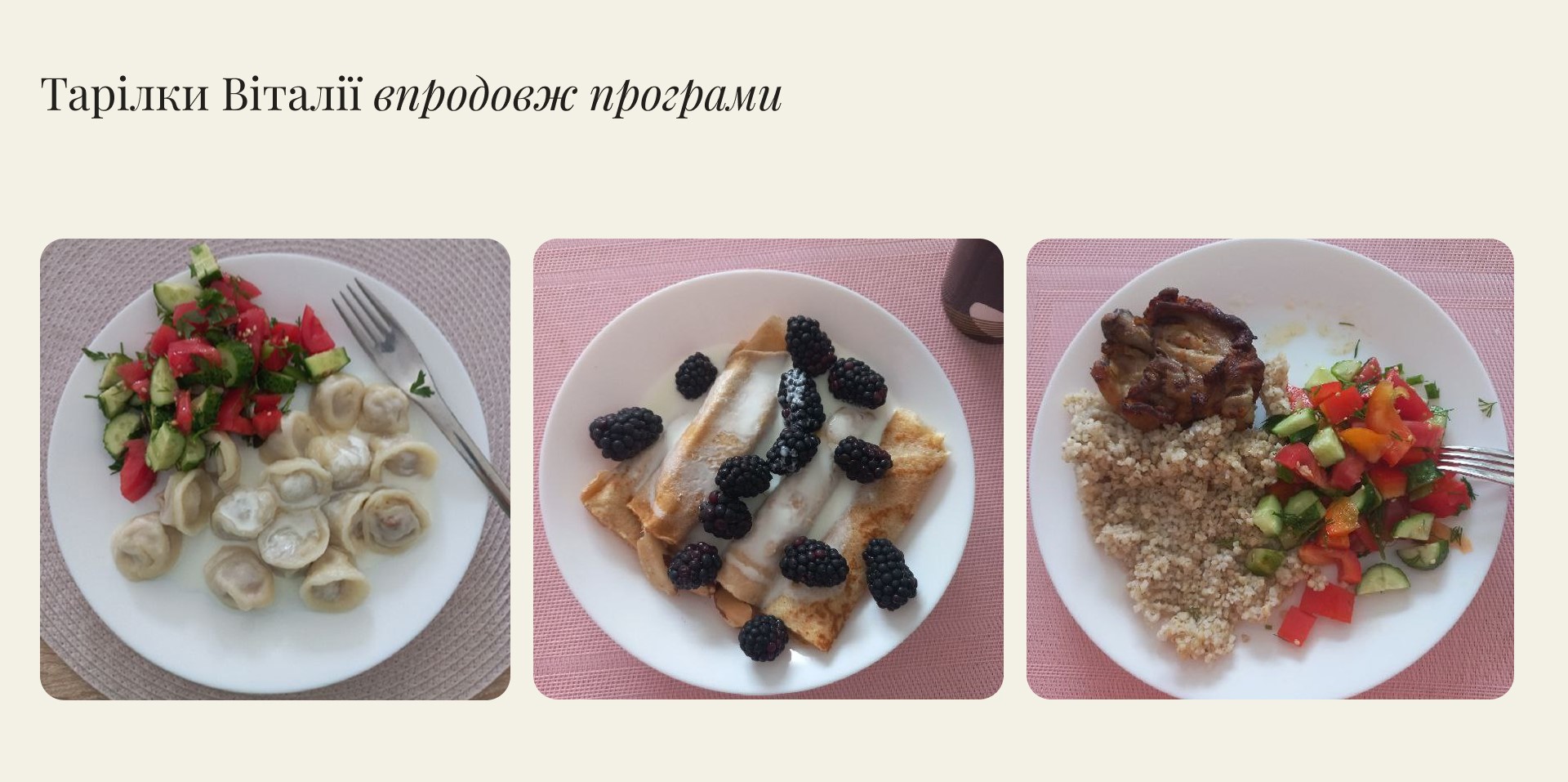
What surprised her most
The biggest surprise wasn’t the scale — it was that her body started asking for movement. By week six she was planning training for the week instead of forcing it. She moved from yoga-only to a real strength rotation. Seven thousand steps a day became default. Her clothes started fitting differently before the weight changed.
She also learned things she hadn’t expected to learn at this point in her life: that two yogurts with the same name can have wildly different protein and sugar profiles, that hydration affects joint pain, that strength training does more for body shape than another year of cardio.
Three months in
By the end of the programme she was down 4.3 kg — from 72.8 to 68.5. Her joints stopped hurting. The folds on her back disappeared. Her bloodwork moved in the right direction.
The visible change wasn’t the point. The point was that for the first time in years she had a method she could keep using — and actually wanted to.
What stayed
Six months later, the routine still holds. Enough protein at every meal. Strength training a few times a week. Steps. Water. Less coffee in the second half of the day. Sweets when she wants them, after meals, within the day.
The biggest shift, in her words, is mental. She stopped restarting. When a hard day or a holiday throws her off, she doesn’t treat it as a failure — she just goes back to the routine the next morning.
“Sweets are okay. Emotional days happen. The point is not starting over — just coming back to the routine.”
— Vitaliia
In numbers
−4.3 kg
in 3 months
Joint pain gone
Strength training she
wants to do
7,000
+ steps daily
Adapted to English from the original Ukrainian. Read the original.